




Your arch is the curved area along the inside of your foot between the heel and the ball. Its height and shape affect how your feet absorb shock, how pressure spreads across the foot, and how your foot moves when you walk and run. Knowing your arch type can help you understand foot pain, choose shoes, and decide what kind of support you need.
This guide explains the main arch types, simple ways to check yours at home, and what each type means for your feet.
The three main arch types
Low arches (flat feet)
The arch is low or collapses when you stand, so most of the sole touches the ground. Low arches are often linked to overpronation, where the foot rolls inward. Many people with flat feet have no symptoms; others experience arch, heel, or knee pain. See understanding flat feet.
Neutral (medium) arches
The arch has a moderate curve. The foot rolls inward a normal amount to absorb shock, then becomes stable for pushing off. Even with neutral arches, long hours standing or high-impact activity can cause discomfort.
High arches
The arch is noticeably raised, so less of the foot touches the ground. Pressure concentrates on the heel and ball of the foot, and high-arched feet tend to absorb shock less effectively. High arches are often linked to supination, where the foot rolls outward. See how to properly support your high arches.
Test 1: The wet footprint test
- Wet the soles of your feet.
- Stand normally on a piece of cardboard, a brown paper bag, or a dark towel.
- Step off and look at your footprint.
- Flat or low arch: You'll see almost the entire sole, with little or no curve along the inner edge.
- Neutral arch: You'll see the heel and ball connected by a band about half the width of the foot, with a clear curve on the inside.
- High arch: You'll see the heel and ball with a very thin band, or no band at all, connecting them.
Test 2: Look at your shoes
Check the soles of a well-worn pair of everyday shoes:
- Wear on the inner edge suggests overpronation, often with low arches.
- Even wear across the heel and ball suggests a neutral foot.
- Wear on the outer edge suggests supination, often with high arches.
Set the shoes on a flat table and look from behind. Shoes that lean inward or outward give another clue.
Test 3: The standing mirror test
Stand barefoot in front of a mirror with your feet hip-width apart and your weight evenly spread. Look at the inside of your feet:
- If your arch touches or almost touches the floor and your ankles roll inward, you likely have low arches.
- If there's a moderate gap under the arch, you likely have neutral arches.
- If there's a large gap and your weight seems to sit on the outer edges, you likely have high arches.
Test 4: The tiptoe test
Look at your arch while sitting, then while standing. If your arch is visible when sitting or standing on tiptoe but flattens when you stand normally, you have flexible flat feet, the most common type. If it stays flat in every position, you may have rigid flat feet, which is worth having checked by a podiatrist.
Your two feet may be different
It's common for one foot to have a slightly different arch than the other. Check both feet separately. If one arch has changed noticeably, especially if it has started to flatten, see a podiatrist, as this can be a sign of a tendon problem.
What your arch type means for support
- Low arches: Usually benefit from firm arch support and motion control to limit inward rolling.
- Neutral arches: Benefit from support that matches the arch and cushioning for long days or high-impact activity.
- High arches: Usually benefit from support that fills in the arch to spread pressure, plus extra cushioning.
At-home tests give you a general idea, but arches aren't simply low, medium, or high; every foot has its own shape. That's why support built from the shape of your own foot fits better than a generic insole sized for an arch category.
Getting support that matches your arch
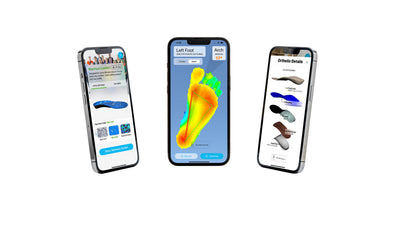
Custom orthotics are made from a model of your own feet, so the support follows your actual arch rather than a category. With Fits Perfect, you scan your feet with your iPhone in the Fits Perfect app, a fast, simple, and accurate 3D scan that captures your arch shape. If you don't have an iPhone, a mail-in foam impression box is available. For everyday shoes, Maximum Comfort is designed for all-day wear, and the Running orthotic suits runners. Every style is $249 with free shipping.
For more, read overpronation: how to tell and how to fix it.
When to see a podiatrist
See a podiatrist if you have ongoing foot pain, rigid flat feet, an arch that's changing, or pain along the inside of your ankle. A professional gait and foot assessment can give you a fuller picture.
Frequently asked questions
How do I know if I have flat feet?
The wet footprint test is a simple start: a footprint showing most of your sole suggests low arches.
Can your arch type change?
Yes. Arches can lower over time due to age, weight changes, pregnancy, or tendon problems.
Do high arches need support?
Yes. Without support, pressure concentrates on the heel and ball of the foot.
Is it bad to have flat feet?
Not necessarily. Many people with flat feet have no symptoms.


